Operation Configuration
Operations
The Enterprise Operations EIE was designed with an opt-in model for operations. An Enterprise Operations device must be purposefully configured by an administrator to enable operations for each device.
Just as the various operations must be specifically enabled, the services allowed to provide data for processing those operation requests must be specified for each device. This is done by establishing Service Filters for Native operations, and by adding them in the Business Object Interface for Business Object operations.
Services
Service Filters and Business Object Interfaces are used to specify the services that are allowed to provide data for processing Enterprise Operations requests. The filters and interfaces are inclusive; only services purposely added are selected.
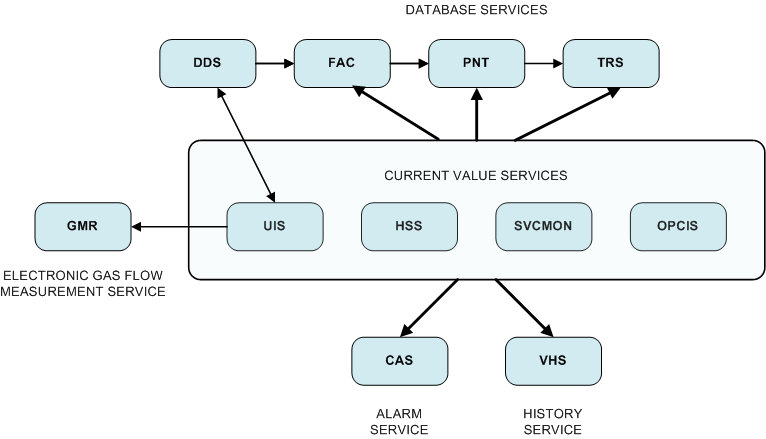
Some of the operations allow you to specify only a Current Value Service (CVS). The request may even be specific to another type of service, such as the Point Service (PNT) or the Facility Service (FAC), however CygNet services have defined relationships with other services in the system. Generally these relationships are defined in the service configuration file. Current Value Services are central in those service relationships. They are connected to all other services in the system. Because of this, many operations allow you to specify only a Current Value Service, and the Current Value Service will then resolve the request to the appropriate service. See Creating and Applying Service Filters for more information.
Some relationships between services are one-to-one, such as the Device Definition Service (DDS) and Universal Interface Service (UIS). Other services have a one-to-many relationship, such as the Point Service (PNT) to several Current Value Services. And still others have a many-to-one relationship, such as the Current Value Services to the VHS.
The diagram below illustrates the most common service relationships.
Note: This diagram is simplified for clarity and does not show all of the relationships.
|
Common Service Relationships |